We Can Forecast Tomorrow’s Weather. But What Can We Say About 2050?

We can forecast whether it will rain tomorrow, how strong the wind will be on Friday, or how high temperatures may climb next week.
But what if the question is about 2050?
It is not possible to forecast the exact weather on a particular day decades from now. What we can investigate is how the climate may change over longer periods – including average conditions, variability and the frequency of certain extremes. This is the fundamental difference between a weather forecast and a climate projection.
Climate projections help answer questions such as: How could typical summer temperatures change by mid-century? Could very hot days become more frequent? How might heavy precipitation or drought conditions change?
But what exactly is an RCP?
RCP stands for Representative Concentration Pathway. These scenarios were developed to explore how the climate could respond to different levels of greenhouse-gas concentrations and radiative forcing. They are not predictions of exactly what will happen.
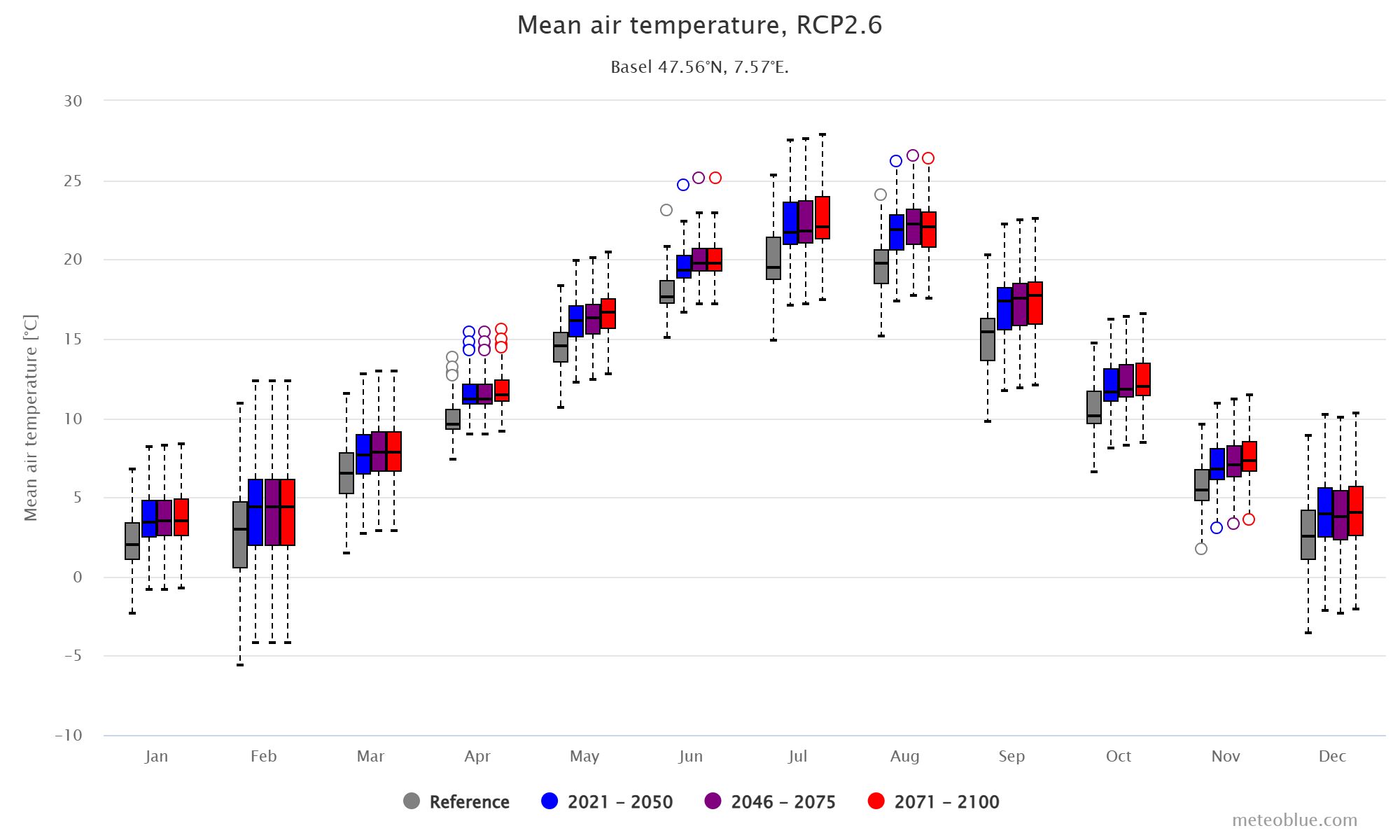
RCP2.6, used in the example below, represents a low-forcing pathway associated with strong climate mitigation.
Climate scenarios are updated over time as emissions trends, technologies and policies evolve, with newer frameworks being developed for the next generation of climate projections.
The example below shows mean air temperature in Basel under RCP2.6, comparing a reference period with three future 30-year periods. The boxplots also show the variability within each period, helping illustrate how the range of possible conditions may shift over time.
And that difference matters for businesses.
A weather forecast can support tomorrow’s operations. But a building, energy asset, production site or infrastructure project may remain in use for 30, 50 or more years. Businesses therefore also need to understand how the climatic conditions around these assets could change during their life time.
With meteoblue climate+, users can explore location-specific climate projections worldwide up to 2100. The service provides climate information for variables including temperature and precipitation, as well as derived indicators such as hot days and tropical nights. Different climate scenarios can be compared to understand how future conditions may develop under different pathways.
Users can analyse future periods visually, download climate data for further analysis and access location-specific Climate Risk Reports, which compare current and projected risks. The reports classify 28 climate risks into five risk classes, helping identify where closer assessment or action may be required.
For businesses, this can help answer practical questions: Which assets may become more exposed to heat or heavy precipitation? How could operating conditions change over an asset’s lifetime? Where might adaptation measures be needed first? And how should climate information be considered in risk assessment, investment planning or EU Taxonomy-related analysis?
This information can help companies assess long-term exposure, prioritise adaptation measures and include future climate conditions in infrastructure, investment and risk-management decisions.
The goal is not to predict the weather on a particular day in 2050. It is to understand how the range and probability of climatic conditions may change, so long-term decisions can account for a changing climate.
Explore climate+ and the data behind this example.