How Do Multiple Weather Models Become One Forecast?

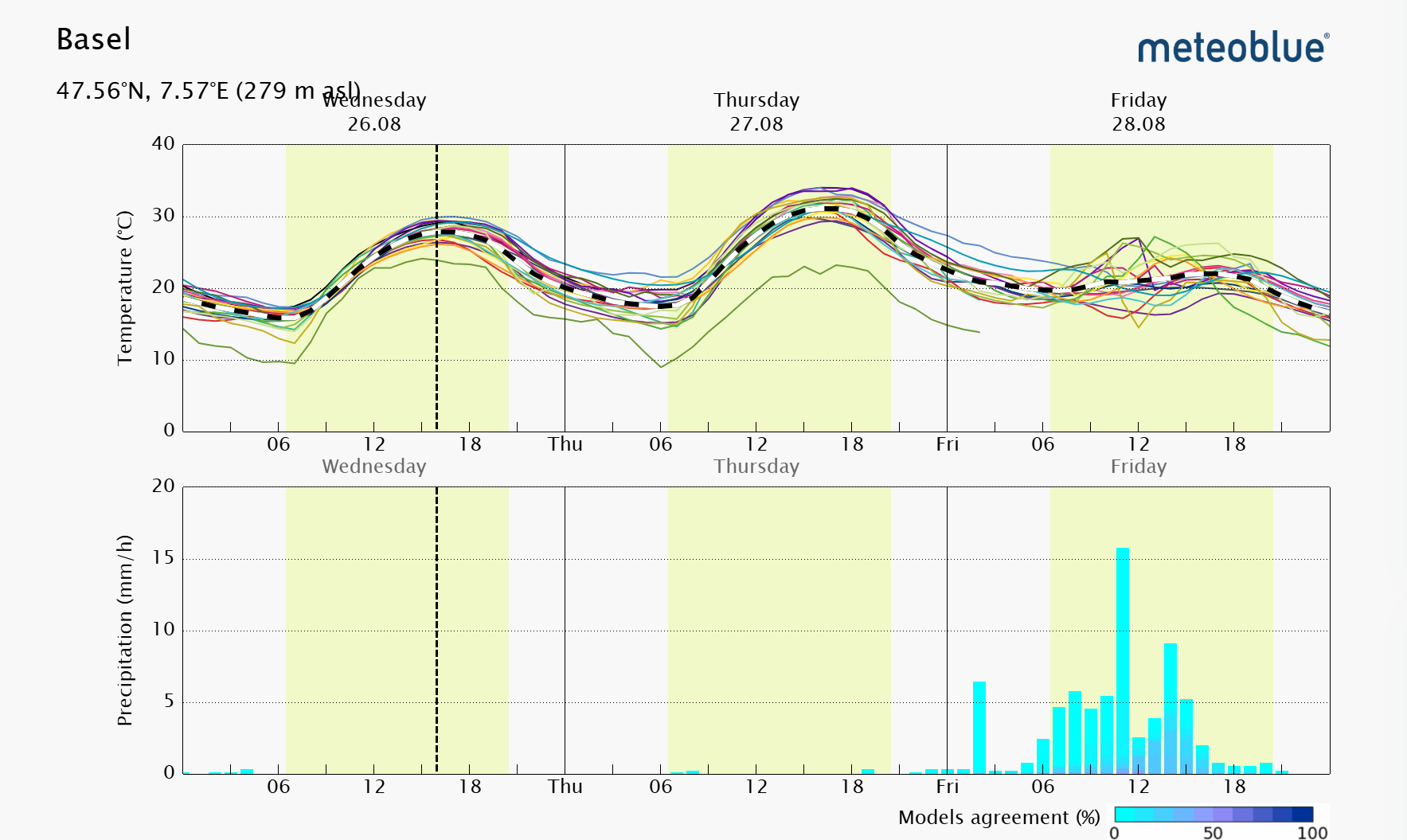
Open a MultiModel forecast for any location and you will often see that the models do not agree completely. One may predict 24°C, another 27°C. Wind speed can differ by several metres per second, while the timing of a temperature change, rainfall or a frontal passage may shift by a few hours.
These differences are normal. Each model starts from its own representation of the atmosphere and processes weather development in a slightly different way. The result is not one obvious answer, but a range of possible outcomes for the same place and time.
Which one is correct?
- Numerical weather prediction models all simulate the same atmosphere, but not in exactly the same way. They differ in spatial resolution, initial conditions, physical parameterisations and numerical methods. Global and regional models also have different strengths depending on the location, weather situation and forecast horizon.
- Comparing several models can therefore be useful. The spread between them gives an indication of how consistently a situation is being predicted. But agreement between models does not automatically mean that the forecast is accurate.
- Several models can share similar biases. A model may systematically overestimate wind speed at one location or struggle to reproduce a local temperature pattern. Raw numerical forecasts also work on a grid: a grid cell represents an area, not the exact conditions at a specific point.
To improve this, we use the meteoblue Learning MultiModel (mLM).
mLM is our machine-learning-based post-processing approach. It evaluates information from multiple models and uses past forecast performance to determine which model combination works best for a particular location.
Where local weather-station measurements are available, mLM can learn from the relationship between previous forecasts and actual observations. For station-specific forecasts, measurements from recent months help adapt the model combination to local conditions.
This also means that the preferred model combination does not have to be the same everywhere. A model that performs well for temperature at one location may not be the best somewhere else. Performance can also differ between variables.
mLM is currently implemented and validated for air temperature, dew point temperature and wind speed. And we continuously verify the results. meteoblue compares forecasts with observations from weather stations worldwide and publishes the results in our monthly Forecast Accuracy Reports, benchmarking mLM against leading global models.
The July 2026 results show that mLM achieved lower Mean Absolute Error than the best raw global model across all six evaluated continents for temperature, dew point and wind speed. The improvement ranged from 24–34% for temperature, 23–36% for dew point and 29–44% for wind speed. The results also show how this advantage develops over the forecast horizon. For temperature, for example, mLM on day 6 was still as accurate as the best raw global model on day 1.
So when models disagree, following the majority is not necessarily the best approach. Combining multiple models with measurements, machine learning and verification helps produce more accurate local forecasts.