Case Study: High-Resolution Climate Modelling for the Swiss Rail Network

Case Study: High-Resolution Climate Modelling for the Swiss Rail Network
The Challenge: 1960s Infrastructure Standards vs. Future Outlook
Current Swiss rail standards for the Neutralisation Temperature – the critical temperature at which a rail is tension-free, and therefore safe to use – were largely established in the 1960s. However, as climate change accelerates, the "old normal" is shifting. SBB (Swiss Federal Railways) has observed an increase in track deformations during hot day periods, indicating that historical thermal stress parameters must be re-evaluated.
The overriding question for SBB was whether the neutralisation temperature thresholds currently in use would still hold under future climate conditions. Crucially, neutralisation temperature is a function of track temperature, not air temperature per se. To bridge this gap, SBB developed a formula for deriving track temperature from air temperature data, enabling their measured track readings to be compared directly against our high-resolution atmospheric outputs. This air-to-track conversion forms a methodological cornerstone of the project and will serve as a practical tool for evaluating the long-term adequacy of neutralisation temperature standards as the climate continues to evolve.
To address this challenge, meteoblue collaborated with SBB and Allianz Fahrweg on a comprehensive research project to redefine infrastructure safety for the next generations.
The Role of meteoblue: Precision at Scale
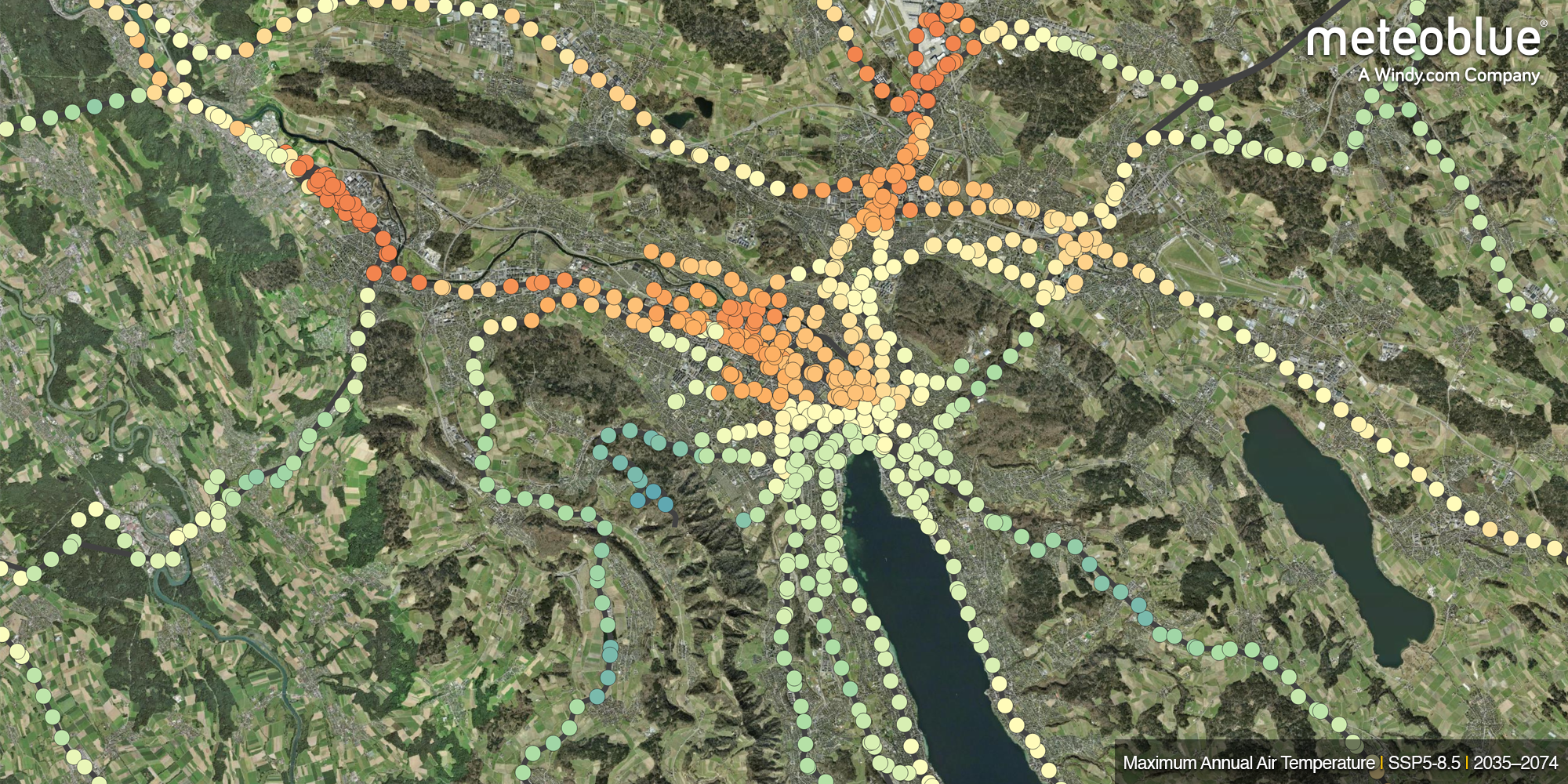
While physical sensors provide vital ground-truth data, it is not feasible to monitor every kilometer of a national network manually. The analysis provided by meteoblue bridged this gap by scaling localised measurements into a nationwide simulation model:
- Granular Mapping: High-resolution 500 × 500 m grid temperature data was provided to cover the entire Swiss standard-gauge network. This allowed for precise thermal analysis even in remote areas far from physical weather stations.
- Long-Term Climate Projections: The study looked well beyond historical data. By utilising advanced climate scenarios across multiple future time horizons, meteoblue models helped SBB prepare for a future in which air temperatures exceeding 40°C become increasingly frequent.
- Topographic and Exposure Analysis: A rail's temperature is heavily influenced by its orientation and the surrounding terrain. By integrating weather data with track exposure models, the study identified that South-West facing tracks are the most vulnerable, with rail temperatures potentially exceeding 60°C.
The Result: A Data-Driven Framework for Operational Safety
The project concluded that existing standards require localised adjustments to remain effective. Based on the insights generated by meteoblue, a new, differentiated neutralisation temperature has been proposed. These evidence-based adjustments are a central element in ensuring track stability and operational safety under the conditions of a changing climate.